


In short:
The same people who taught themselves online banking and social media often don’t want to hear about a new program, let alone one that works with artificial intelligence. In this article I explain why this happens, what Istat and Eurostat data show, and why using AI only to write an email risks becoming the new comfort zone. To close, five practical steps to get started.
Estimated reading time: 6 minutes
Over the past few years I have met many employees of professional associations and many business owners. Capable people who know their field inside out, but who have been relying on the exact same software for ten or fifteen years. Excel files passed around, data manually copied from one tool to another, shared folders where finding anything has become nearly impossible.
When I suggest moving to more powerful tools, in the cloud and able to talk to each other, the answer I hear most often is always the same: “we’ve always done it this way”.
I completely get it. Change is uncomfortable and takes real effort. The gentle truth, though, is that staying still often carries a much higher hidden cost. Many leaders and teams simply don’t realise how much friction, stress and extra work the old ways are silently causing the organisation they work for or the business they run.
A photo on social media, yes. A new program, no.
And yet there’s a fascinating paradox here. The same people who resist new software at work have taught themselves to post a photo on social media, make a bank transfer through a banking app, order groceries from their phone. No training course, no instruction manual. The capacity to learn is there. The difference lies elsewhere: in my private life I see the benefit straight away and I can touch it, I save time and I get what I want. At work, on the other hand, I am the one who makes the effort to learn, but the reward feels distant, abstract, and mostly beneficial to the company rather than the individual. That is why change cannot be left to individual goodwill. It must be driven from the top, but nurtured and supported, step by step, for the people who live it every day.
Why we prefer to stay where we are
There is an explanation, and it has nothing to do with laziness. In 1988 two economists, William Samuelson and Richard Zeckhauser, gave this behaviour a name: status quo bias. Simply put, we tend to prefer the situation we are in, even when the alternative is clearly better.
Daniel Kahneman and Amos Tversky had already proven that a loss hurts more than an equivalent gain brings satisfaction. We experience giving up a habit as a certain loss, while the advantages of the new tool feel like nothing more than a promise.
What’s missing from this calculation is the most critical factor of all: the silent cost of falling behind. At first you don’t see it, then it grows month after month.
What the numbers say
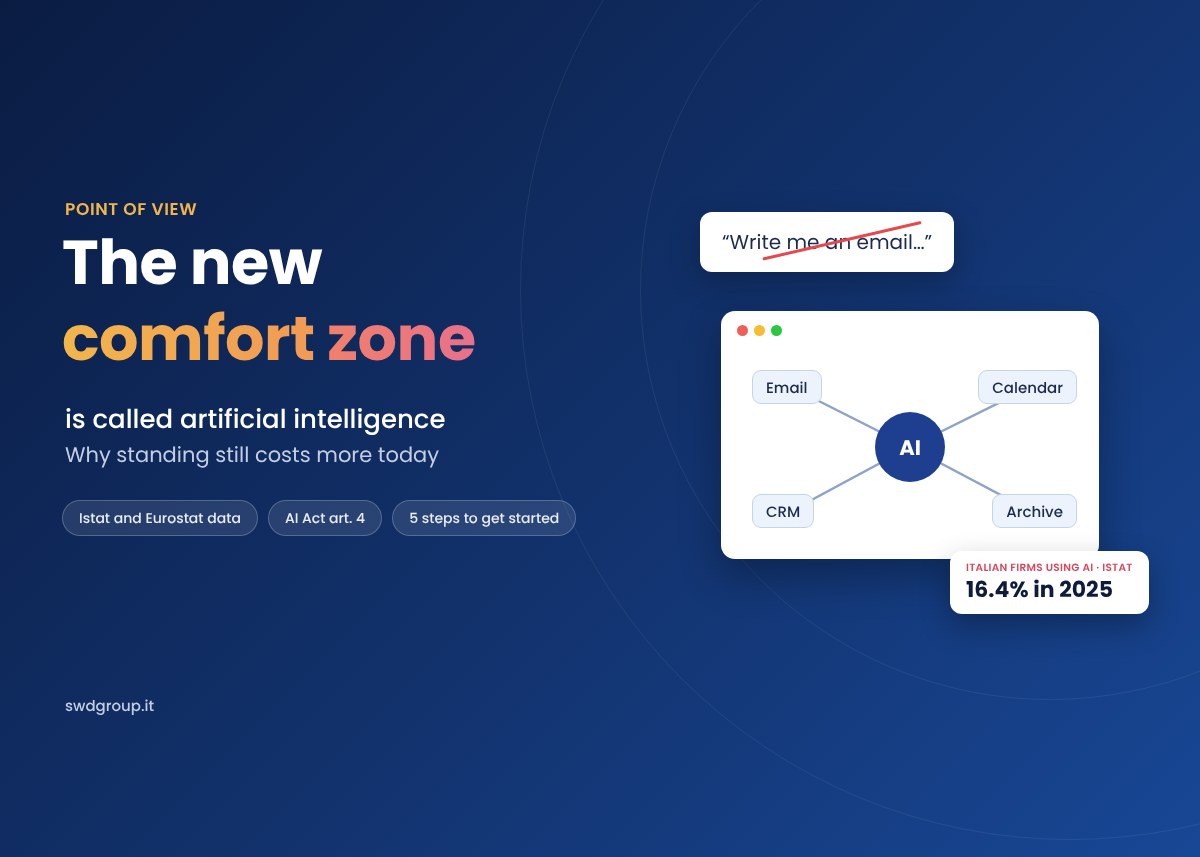
The data from Istat is clear. In 2023 only 5% of Italian companies with at least 10 employees used at least one artificial intelligence technology, rising to 8.2% in 2024 and 16.4% in 2025. Among large companies, that figure already exceeds 50%.
Read the other way round, this means that more than eight companies out of ten still don’t use AI. According to Eurostat, the European average stands at 20%, and Denmark reaches 42%. At an individual level, we are behind too: in the EU nearly one in three citizens used generative AI tools in the three months prior to the survey, in Italy about one in five.
The World Economic Forum estimates that 39% of workers’ core skills will change by 2030, and 63% of employers already cite the skills gap as the main barrier to transformation.
Today running is not enough, we need to pick up the pace. And those who wait until tomorrow will not only have to close today’s gap, but the one that keeps widening in the meantime.
Who remembers the typewriter?
In the 1990s, in many offices, the typewriter and the first computer sat on the same desk. Some said the computer was a fad, arguing that the old way was faster. A few years later nobody was asking that question anymore: those who had learned in time were running the office, those who had resisted had to catch up.
History has taught us this lesson before. In every industrial revolution, those who failed to adapt found themselves looking for work day by day, with no certainty about tomorrow. But the revolution we are living through now, the fourth, has one huge difference: the previous ones unfolded over decades, this one is measured in years.
Using AI only to ask questions is the new comfort zone
Then there is a subtler comfort zone, which many people who already use AI are entering too. You open a chat, ask for a summary, have it write an email. That’s fine and useful, but it is only the beginning.
The real step forward is integrating AI directly into the programs we use every day in the office: email, calendar, management software, CRM, document archive. Picture an AI that reads incoming requests and drafts the replies, updates the files, reminds you of deadlines and moves data from one program to another without anyone having to copy and paste manually.
To get there, though, you need cloud software, interoperable programs that talk to each other and clear rules on who can do what with the data, always under human oversight and in compliance with the GDPR. Those who stay tied to old software aren’t just missing today’s opportunities, they are also closing the door on tomorrow.
Where to start
There is no need to turn everything upside down tomorrow morning. What matters is simply taking that first step, and knowing exactly where to start.
- List the programs you use and the moments when data is manually copied, because that is where most time is lost.
- Choose a single process to start from, small and easy to measure, for example managing incoming mail or requests from customers and members.
- Verify your infrastructure: make sure your software is cloud-based and fully interoperable. For public administrations it must run on ACN-qualified infrastructure and services.
- Train your people. Article 4 of the AI Act, as updated by Regulation (EU) 2026/1744, asks those who use AI systems to take measures to support their staff’s skills. Beyond compliance, it is the only way to make change really work.
- Track the impact: measure time saved, errors prevented and tasks completed.
The first step
Staying in your comfort zone looks like the safest choice, but that is exactly where the cost of standing still quietly accumulates. Better to decide today how to change than to be forced to do it tomorrow, on someone else’s terms and timeline. Because tomorrow will come, there’s no doubt about it.
If you run a company, a professional association or a public body and want to figure out where to begin, let’s connect. This is what we do every day with companies, professional associations and public bodies. I am offering a free, no-obligation 30-minute discovery call: together we’ll analyse your current software setup and identify the first workflow where artificial intelligence can deliver real value. Not as vendors, but as partners.
Don’t put off until tomorrow what you can do today.
Or write to me: posta@swdweb.it
Leonardo Pantaleo
CEO, SWD Group
Sources
- Istat, Imprese e ICT – Anno 2025 (15 December 2025)
- Eurostat, Use of artificial intelligence in enterprises
- Eurostat, The use of AI technologies in the EU – 2026 edition, summary by Centro Studi TIM
- World Economic Forum, Future of Jobs Report 2025
- Agenda Digitale, Digital Omnibus AI: cosa cambia per le imprese
- Samuelson W., Zeckhauser R., Status Quo Bias in Decision Making, Journal of Risk and Uncertainty, 1988
- Kahneman D., Tversky A., Prospect Theory: An Analysis of Decision under Risk, Econometrica, 1979