



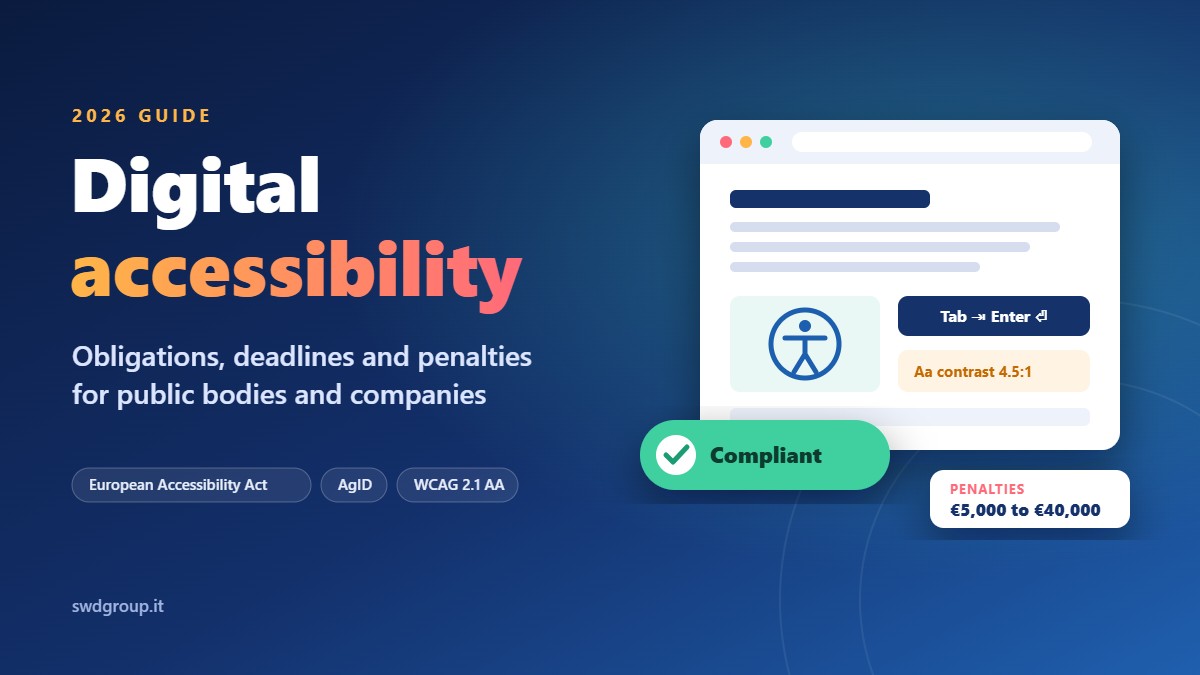
In short. Website and app accessibility is a legal requirement for Italian public administrations and for a growing number of private companies. Since 2026 AgID, the Agency for Digital Italy, also has a single enforcement procedure with set timeframes. This guide covers who must do what, the deadlines, the penalties and the mistakes we see most often.
Estimated reading time: 7 minutes
A website is a complex thing: a public body has forms, an online register, transparency pages and PDFs uploaded by many hands; a company has catalogues, checkouts, customer areas and apps. Accessibility always seems to be the last item on the list. Today it is near the top because the rules are clearer and someone is enforcing them.
What “accessible” means for a public body or a company
A website or app is accessible when anyone, including people with disabilities, can use its services, whether with a screen reader, a magnifier, voice commands or just a keyboard: the citizen who submits an application or pays a fee on their own, the customer who buys or manages a subscription without barriers. If a digital service is not accessible, for some users it simply does not exist.
The legal framework at a glance
Italy has two parallel tracks: one built for public administration, the other for the market.
- Law 4/2004 (the “Stanca Law”): applies to public administrations, public economic bodies and public service concessionaires. Directive (EU) 2016/2102, transposed by Legislative Decree 106/2018, introduced the accessibility statement, the feedback mechanism and monitoring. Decree-Law 76/2020 extended it to private companies offering services to the public through websites or apps with an average turnover above €500 million over the last three years (art. 3, paragraph 1-bis).
- Legislative Decree 82/2022, which transposes the European Accessibility Act (Directive (EU) 2019/882): in force since 28 June 2025, it covers products and services offered to consumers by businesses of any size, defined by sector rather than turnover.
- AgID guidelines: they set out technical requirements and checks. For services under Decree 82/2022, the Guidelines on the accessibility of services adopted by Determination no. 38/2026 apply (Official Gazette no. 69 of 24 March 2026). The common technical reference is the European standard EN 301 549, which points to W3C WCAG 2.1 level AA.
- AgID Regulation (Determination no. 84 of 15 May 2026): the most important change. It governs inspections and penalties for public bodies, large private companies under the Stanca Law and services under Decree 82/2022, replacing the previous regulations (Determinations 357/2019 and 355/2022). It adds no new technical requirements, but makes enforcement structured and time-bound.
What public administrations must do
Accessible websites and apps. All those the body owns, not just the main institutional site.
Accessibility statement by 23 September. One for each website and app, filed only through AgID’s online form; it is valid from 24 September to 23 September of the following year and generates a link to place in the website footer or the app’s store listing. Access is managed by the Digital Transition Manager (RTD): since 2026 the form has distinguished between Administrator and Delegate profiles, so the RTD can let a colleague enter statements and objectives.
Annual accessibility objectives by 31 March, listing the planned improvements.
A working feedback channel. It must be stated in the accessibility statement so users can report barriers or request accessible content. It is not a formality: reports left unanswered can be escalated to AgID’s Digital Ombudsman.
Compliant procurement. Under the Stanca Law, contracts to build or modify websites and apps without accessibility requirements are null and void.
Note: the statement is not a certificate. Honestly declaring partial compliance, backed by an improvement plan, is far more solid than a superficial statement.
What companies must do
Large private companies under the Stanca Law (average turnover above €500 million) must meet the accessibility requirements. For those providing the services covered by Decree 82/2022, AgID specifies that the annual statement is no longer required: instead, they must provide the accessibility information set out in the decree.
Businesses in European Accessibility Act sectors, of any size: e-commerce, consumer banking, electronic communications and access to audiovisual media, passenger transport (websites, apps, e-ticketing, real-time information), e-books and dedicated software. Microenterprises providing services are exempt, meaning fewer than 10 employees and annual turnover or balance sheet total not exceeding €2 million; the exemption does not apply to products. Some requirements may be waived where they would fundamentally alter the service or impose a disproportionate burden, but the waiver must be assessed and documented.
Penalties: what public bodies and companies risk
Public administrations. Article 9 of the Stanca Law provides for managerial and disciplinary liability (articles 21 and 55 of Legislative Decree 165/2001), on top of any civil or criminal liability, and non-compliance affects managers’ performance appraisal. The consequences fall on the people in charge, not on the body in the abstract. Add to that the nullity of non-compliant contracts and the risk of litigation from anyone unable to use a service.
Companies. Article 24 of Decree 82/2022 sets fines from €5,000 to €40,000 for breaching the requirements, scaled by severity and users affected, and from €2,500 to €30,000 for failing to cooperate with the authority or to comply with its orders. For large companies under the Stanca Law, fines reach up to 5% of turnover. For services under Decree 82/2022, if non-compliance continues, AgID can set a deadline to take the service offline or remove the app from the stores.
How AgID enforcement works
Regulation 84/2026 sets out two stages. In the preliminary review, triggered by reports, complaints or monitoring, AgID checks, identifies non-conformities and asks for corrections within a proportionate timeframe. If nothing changes, the penalty procedure begins: formal notice, the right to respond, a final warning with a strict deadline, and the decision.
The logic is: fix first, penalise later, and those who comply in time have their case closed. That is why it pays to be ready, with an up-to-date statement where required, a credible remediation plan and a record of what has been done.
The mistakes we see most often
- Forgetting “secondary” sites: event portals, project microsites, dedicated areas.
- Thinking accessibility only concerns the public sector, or that “microenterprise” means exempt from everything.
- Copying last year’s statement without a fresh technical check.
- Overlooking documents and critical flows: scanned PDFs, forms that cannot be filled in with a keyboard, checkouts and private areas.
- Relying on a widget that promises compliance with one line of code. Accessibility is built into code, content and editorial processes.
- Leaving suppliers and editors out: if the contract does not require compliance, or whoever publishes is not trained, the site stops being accessible with the first badly uploaded attachment.
As with any digital project, the point is the process, not the tool: accessibility works when it becomes part of how the organisation produces and publishes information, not when it is a one-off fix at year end. It is the same approach we take when we design websites and e-commerce and mobile apps, and when we help a professional body’s systems talk to each other.
Frequently asked questions
Does my company have to make its website accessible?
It depends on sector and size. If you offer consumers services such as e-commerce, banking, passenger transport or electronic communications, Decree 82/2022 applies unless you are a service microenterprise. If your average turnover exceeds €500 million and you offer services via a website or app, the Stanca Law applies as well.
When must the accessibility statement be published?
Public administrations must file it by 23 September each year, for every website and app, through the AgID form. Annual accessibility objectives must be published by 31 March.
What are the penalties for an inaccessible website?
For companies under Decree 82/2022, €5,000 to €40,000, plus €2,500 to €30,000 for failing to cooperate with AgID; for large companies under the Stanca Law, up to 5% of turnover. In public administrations, managers are liable on a disciplinary and managerial level.
Is an accessibility widget enough to comply?
No. A widget may help some users, but it does not fix code, content structure, documents and forms, which are what gets checked against EN 301 549 and WCAG 2.1 AA.
If AgID contacts us, is a fine immediate?
No. Regulation 84/2026 starts with a review and a request to fix the issues. A penalty only follows if you do not comply within the deadline.
Want to know where your organisation stands?
Let’s review your websites and apps together: accessibility statement, the obligations that actually apply to you and the priorities for action, starting from your organisation’s real situation.
Lorenzo Longhi
Business Consultant, SWD Group – lorenzo@swdweb.it – +39 392 9633884


You must be logged in to post a comment.